R0 vs. Rt: Disease Potential vs. Disease Reality
July 7 2026 • 2 min read

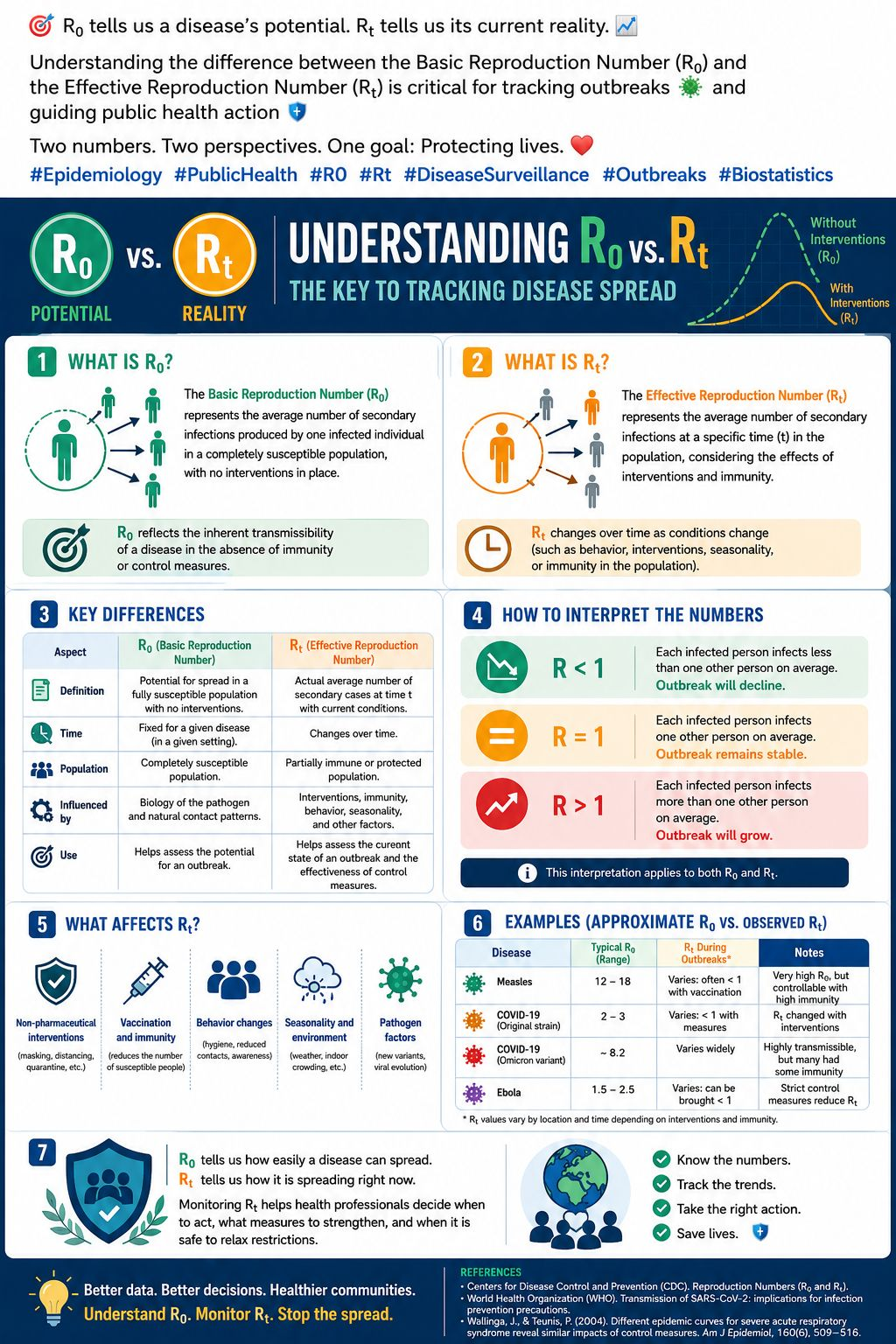
Image by Manus AI
In epidemiology, R0 and Rt are often used interchangeably — but they capture different moments in an outbreak. Understanding the distinction is critical for tracking outbreaks and guiding public health action.
R0 (Basic Reproduction Number): The Potential
R0 is the average number of secondary infections one infected person would cause in a fully susceptible population, with no immunity and no interventions in place. It's a theoretical baseline — a measure of a pathogen's inherent transmissibility under ideal conditions for spread.
Key characteristics of R0:
- Fixed baseline: Usually calculated at the very beginning of an outbreak.
- Biological property: Reflects the biology of the pathogen and natural contact patterns.
- Theoretical: Assumes everyone is susceptible.
Rt (Effective Reproduction Number): The Reality
Rt (sometimes written as Re) is the average number of new infections caused by one infected person at a given point in time, in the actual population as it exists then — partial immunity, current behavior, active interventions, and all. It shifts continuously as the outbreak evolves.
Key characteristics of Rt:
- Dynamic: Changes over time as conditions change (behavior, interventions, seasonality).
- Actionable: Helps assess the current state of an outbreak and the effectiveness of control measures.
- Contextual: Considers interventions, immunity, and other real-world factors.
Reading Rt
Tracking Rt in real time is one of the main tools public health teams use to judge whether interventions are working:
- 🟢 Rt < 1 → The outbreak is shrinking
- 🟡 Rt = 1 → Transmission is holding steady
- 🔴 Rt > 1 → The outbreak is growing
💡 The Bottom Line
R0 tells you what a disease is capable of under ideal spreading conditions. Rt tells you what it's actually doing right now. Because Rt responds to vaccination, distancing, variants, and behavior change, it is the compass used to guide decisions during an active outbreak.
Better data. Better decisions. Healthier communities. Understand R0. Monitor Rt. Stop the spread.