Reporting Standards for Exploratory Factor Analysis: A Guide to Transparency
July 12 2026 • 2 min read

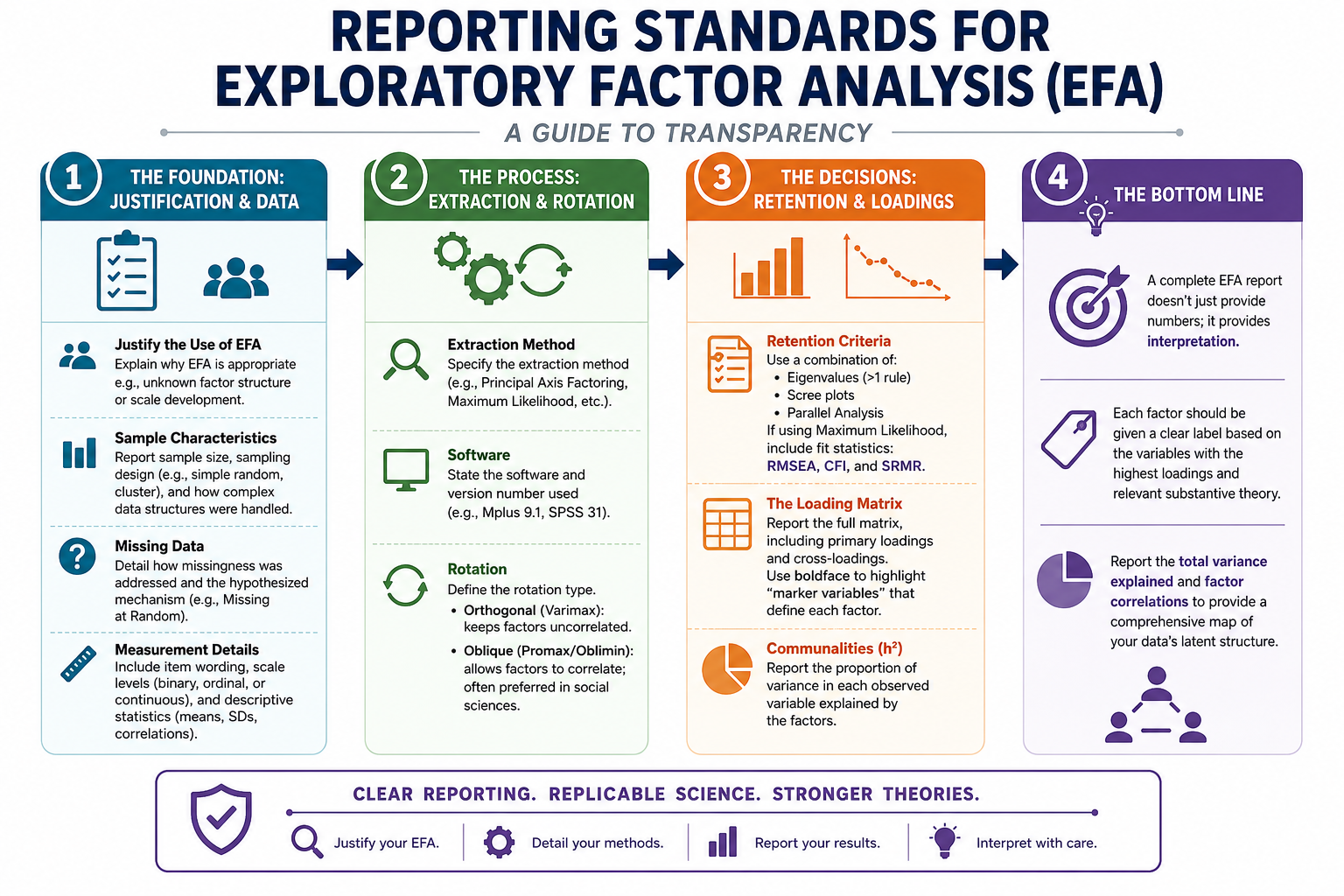
Image by AI
Exploratory Factor Analysis (EFA) is a multivariate statistical method used to determine the underlying dimensions, factors, or latent variables within a set of observed variables. To ensure your findings are replicable and interpretable, specific technical details must be transparently reported.
The Foundation: Justification & Data
Before diving into the numbers, researchers must justify the use of EFA over other methods like Confirmatory Factor Analysis (CFA). This is typically necessary when the factor structure is previously unknown or when developing a new scale.
Critical reporting elements for the foundation include:
- Sample Characteristics: Report the sample size, sampling design (e.g., simple random vs. cluster), and how any complex data structures were handled.
- Missing Data: Detail how missingness was addressed and the hypothesized mechanism (e.g., Missing at Random).
- Measurement Details: Include item wording, scale levels (binary, ordinal, or continuous), and descriptive statistics like means and correlations.
The Process: Extraction & Rotation
Transparency in the mathematical approach allows others to reproduce your analysis exactly.
Key characteristics of the process:
- Extraction Method: Specify if you used Principal Axis Factoring, Maximum Likelihood, or another method.
- Software: State the software and version number used (e.g., Mplus 9.1 or SPSS 31).
- Rotation: Define the rotation type. While Orthogonal (Varimax) keeps factors uncorrelated, Oblique (Promax/Oblimin) is often preferred because it allows factors to correlate, which is more realistic in social sciences.
The Decisions: Retention & Loadings
How you decided on the final number of factors is one of the most critical parts of the report.
- Retention Criteria: Use a combination of Eigenvalues, Scree plots, and Parallel Analysis. If using Maximum Likelihood, include fit statistics like RMSEA, CFI, and SRMR.
- The Loading Matrix: Report the full matrix, including primary loadings and cross-loadings. Use boldface to highlight "marker variables" that define each factor.
- Communalities (h²): Report the proportion of variance in each observed variable explained by the factors.
💡 The Bottom Line
A complete EFA report doesn't just provide numbers; it provides interpretation. Each factor should be given a clear label based on the variables with the highest loadings and relevant substantive theory. By reporting the total variance explained and factor correlations, you provide a comprehensive map of your data's latent structure.
Clear reporting. Replicable science. Stronger theories. Justify your EFA. Detail your methods. Interpret with care.